
Out-of-Home Advertising in Japan: 3 Creative Directions That Actually Earn Attention
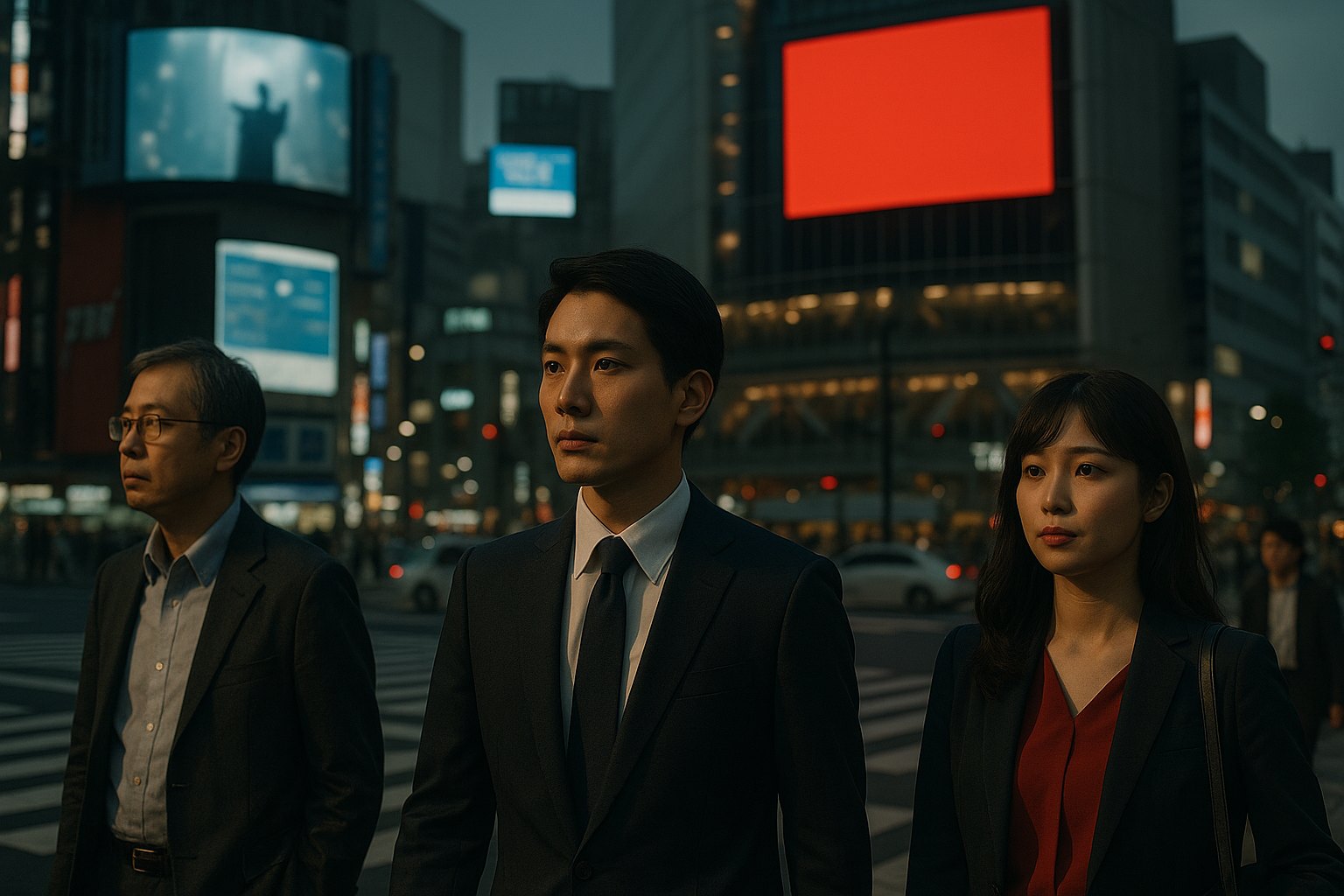
Japan's Streets Are a Media Channel, Are You Treating Them Like One?
Walk through Shinjuku at rush hour, linger in Shibuya on a Saturday afternoon, or step off the Shinkansen in Osaka, and you will notice something that surprises many foreign marketers: out-of-home advertising in Japan is not wallpaper. People look at it. They photograph it. They share it. In a country where urban density is extraordinary and commute culture runs deep, physical advertising has a reach and a cultural weight that is difficult to replicate through digital channels alone.
Yet most foreign brands enter the Japanese OOH market with creative that was built for a different audience in a different context. The result is spend that produces impressions but generates little memory, engagement, or downstream digital activity. That is the gap this article is designed to close.
At OJI DIGITAL, we work with foreign and Japanese brands on integrated marketing in Japan, and OOH is a question we return to constantly, not as a standalone media buy, but as a surface that, when conceived correctly, amplifies everything else. Below are the three creative directions we recommend most consistently, and the practical thinking behind each.
Direction 1: Build for Fan and Community Culture, Not General Audiences
Japan has one of the most active fan cultures in the world. Whether the object of devotion is an entertainment property, a sport, a musician, an anime series, or even a consumer brand, committed fans in Japan demonstrate their loyalty visibly and collectively. They travel to see physical installations. They queue for limited merchandise. They document their fandom on social platforms and share it within tight-knit communities.
This creates a specific and powerful opportunity for OOH: advertising that speaks directly and specifically to a community, rather than broadcasting to the broadest possible demographic, often outperforms on every metric that matters, earned media, social sharing, word of mouth, and actual conversion.
What this looks like in practice
- Design for recognition, not introduction. If your brand has an existing community in Japan, however small, OOH creative should reward them. Use references, imagery, or language that insiders will immediately understand and that will prompt them to share. A fan who feels seen by your poster will do more distribution work than any paid amplification.
- Treat station areas and pilgrimage zones seriously. In our experience, certain locations in Tokyo, Osaka, and other major cities have informal status as places fans gather or pass through. Placing creative in these zones, rather than simply buying the highest-traffic slot, dramatically increases the likelihood of community-driven sharing.
- Make the installation feel like an event. A birthday tribute to a beloved character, a countdown to a launch framed as a celebration, or a creative that evolves day by day: these formats invite fans to return and document the changes. The OOH unit becomes content in itself.
The practical implication for foreign brands is straightforward but often resisted: resist the urge to use OOH solely to build broad awareness. In a market as media-saturated as Japan, specificity is a competitive advantage.
Direction 2: Go Experiential, Give People Something to Do, Not Just See
The most shared out-of-home advertising in Japan, in our observation, is almost never passive. It invites participation. It creates a moment that justifies being photographed and posted. This is not a gimmick, it reflects a durable truth about how social platforms have changed the value equation for physical advertising.
When a commuter or tourist shares a photo of your OOH unit, you have effectively received a paid placement in their social feed, delivered with personal endorsement, to an audience that trusts them. In Japan, where platforms like X (formerly Twitter) and Instagram have substantial, highly active user bases, the multiplier effect of earned social sharing is significant. We consistently recommend that clients treat the potential for organic social amplification as a primary design brief, not an afterthought.
Formats worth investing in
- 3D and anamorphic digital displays. Large-format digital screens capable of displaying three-dimensional illusions have earned genuine public attention in major Japanese cities. The key creative requirement is that the illusion must reward the specific viewing position passers-by naturally occupy. Generic 3D content feels like a screensaver; content designed for place and audience feels like a spectacle.
- Interactive or responsive elements. Digital OOH units that respond to weather, time of day, crowd density, or simple touch/motion inputs generate far higher dwell time and photograph rates than static equivalents. The interaction does not need to be complex, the surprise of a unit that knows it is raining, and adjusts its creative accordingly, is enough to stop someone in their tracks.
- Physical texture and dimension on traditional formats. Not every market or budget calls for digital screens. Tactile, sculptural, or dimensional elements added to traditional poster or billboard formats create the same stopping power at lower cost. A poster that extends into three-dimensional space, or that incorporates an unexpected material, earns a second look, and a photograph.
The experiential design brief we give our clients
Before finalising any OOH creative, ask: if someone photographs this unit and posts it with no caption, does the image communicate something compelling on its own? If the answer is no, the unit is not yet working hard enough. The photograph test is a blunt instrument, but it is an honest one.
Direction 3: Design the Unit as the Beginning of a Digital Journey
Out-of-home advertising in Japan should not be evaluated in isolation from your digital marketing in Japan. The most effective OOH strategies we develop treat the physical unit as the first touchpoint in a sequence, not the only one.
This means designing OOH creative with explicit digital onramps: QR codes that lead somewhere genuinely worth visiting, social handles presented as an invitation rather than an afterthought, hashtags that are short enough to remember and specific enough to own, or AR triggers that reward users who point their phone at the unit. Each of these mechanisms converts passive exposure into an active relationship, and gives you the data to understand which placements and creatives are actually driving engagement.
Making the digital bridge work
- The destination must justify the journey. A QR code that leads to a generic homepage is a broken promise. The landing experience should feel like a reward for curiosity, exclusive content, a limited offer, an interactive moment, or at minimum a page that clearly continues the story the OOH unit began.
- Localise the digital layer fully. Foreign brands frequently invest in strong Japanese-language OOH creative, then send users to an English-language digital experience. This disconnection is particularly jarring in Japan, where consumer expectations around attention to detail are high. The digital destination must match the linguistic and aesthetic register of the physical unit.
- Use retargeting to close the loop. In Japan, digital advertising platforms allow retargeting of users in geographic proximity to OOH placements. We strongly recommend building retargeting audiences that capture users in the vicinity of your key OOH sites during the campaign period. This allows you to serve follow-up digital creative to people who were likely exposed to the physical unit, measurably extending the campaign's reach and frequency in a cost-efficient way.
The result of this integrated approach is an OOH investment that generates measurable digital outcomes, not just impressions on a media plan. For foreign brands who need to justify Japan market spend to global stakeholders, this kind of accountability changes the conversation entirely.
A Note on Creative Adaptation for Japan
Across all three directions, one principle holds: creative that was built for another market rarely performs as intended in Japan, even when translated. Japanese visual culture, typographic conventions, and aesthetic standards are distinctive. Consumers notice when work has been adapted rather than conceived, and in a high-craft market, the distinction matters.
We recommend that foreign brands budget for Japan-specific creative development, not localisation. That does not necessarily mean rebuilding from scratch; it means ensuring that at least the visual language, copywriting, and design decisions reflect genuine familiarity with the market. The difference in performance, in our experience, is not marginal.
The Street Is Your Widest Digital Channel
The most important shift in how we think about out-of-home advertising in Japan is this: the street is no longer a broadcast medium. It is a social one. Every unit you place in a high-attention environment is a potential piece of content, a community signal, and a digital onramp, if you design it to function that way.
Foreign brands that treat OOH as a blunt awareness tool will continue to generate impressions without momentum. Those that approach it as a creative and strategic discipline, one that is integrated with fan culture, built for experiential engagement, and connected to a coherent digital ecosystem, will find that Japan's streets are among the most powerful media channels available to them.
We expect this dynamic to intensify as digital and physical advertising continue to converge. The brands building that capability now will have a meaningful head start.