
Solo Dining, Solo Shopping, Solo Travel: How Japan's Ohitorisama Shift Rewires Your Acquisition Funnel
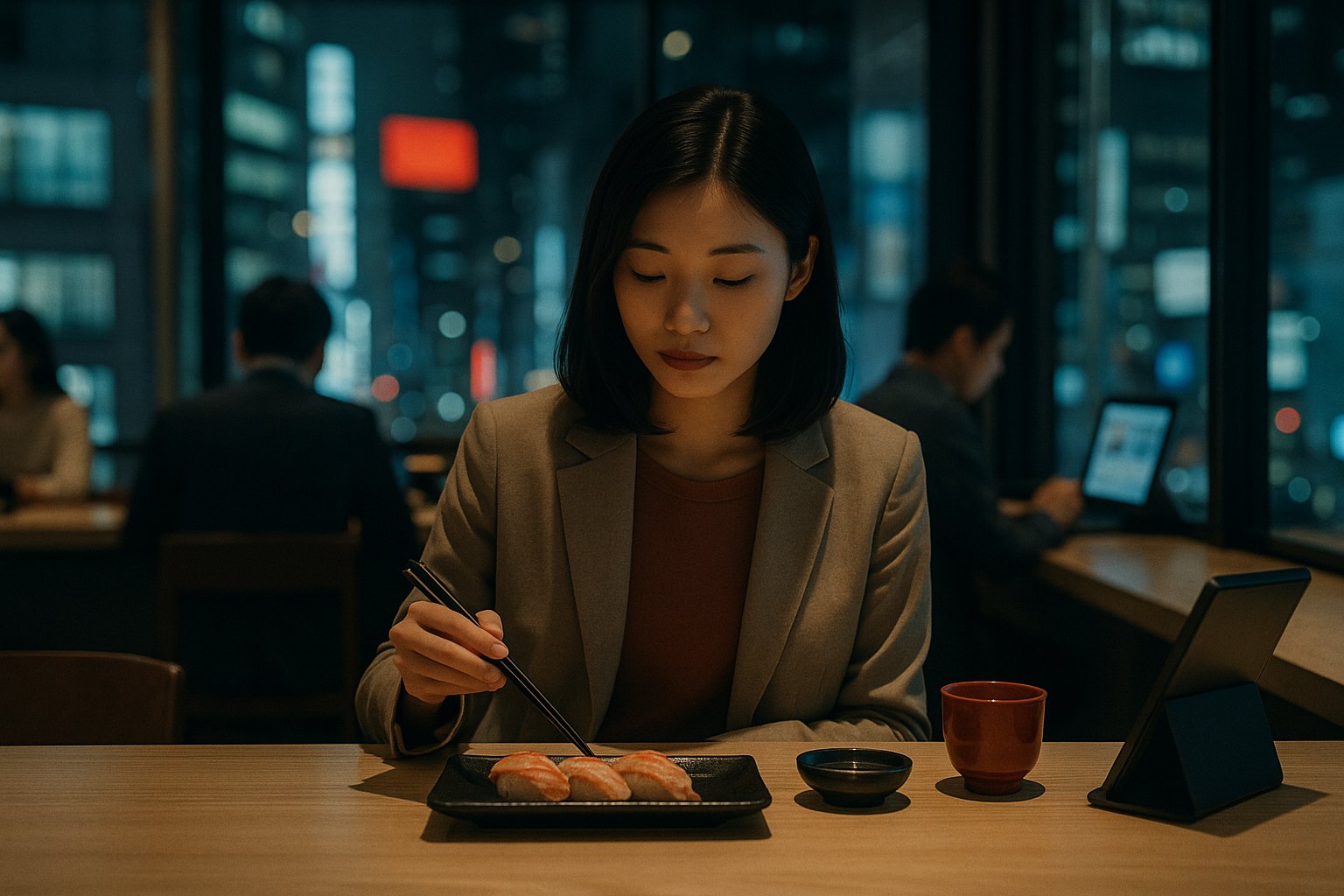
The Lone Diner at the Counter Isn't an Edge Case Anymore
Walk into a ramen restaurant in Tokyo on a Tuesday evening. Count the solo diners. Then count again at a hotel breakfast buffet on a Saturday morning. Or at a domestic airport gate for a weekend trip to Kyushu. The pattern is consistent, and it has been building for years: in Japan, eating alone, travelling alone, and shopping alone have moved from mildly stigmatised behaviour to a fully affirmed lifestyle choice, one with its own vocabulary.
Ohitorisama (おひとりさま), loosely, "a party of one", is the term that has coalesced around this shift. It began as a polite restaurant greeting for solo guests and became something larger: a cultural signal that doing things alone is not a consolation prize but a deliberate, pleasurable way to spend time and money. For brands serious about solo consumer trend Japan marketing, this is not a niche to optimise around the edges. It is a primary demand driver that, in our view, touches almost every consumer category.
Who Is Ohitorisama, Really?
The solo consumer in Japan is not a monolith, but the core of the movement, the group with both the spending power and the clearest self-identification, skews strongly toward women aged 25 to 45. These consumers tend to be urban, professionally employed, and increasingly comfortable asserting that time spent alone is time well spent. Many are single; many others are partnered or married but carving out solo occasions as a form of personal renewal.
What makes this segment commercially interesting is not just its size, which by most reasonable estimates is growing, but its intentionality. The ohitorisama consumer is not a reluctant solo, she has made a considered choice, she has researched her options carefully, and she is willing to pay a meaningful premium for an experience designed around her. A counter seat at an omakase restaurant, a single-occupancy hotel room priced fairly (not penalised), a skincare set sold as a single-serving trial rather than a two-person bundle, these are not compromises. They are the product.
In our experience working with brands across categories in Japan, the marketers who outperform their peers in this segment are the ones who stopped treating "solo" as a modifier and started treating it as the primary use case.
Why This Rewires Your Acquisition Funnel
A traditional consumer acquisition funnel is built on social influence: awareness spreads through group recommendation, consideration is shaped by peer comparison, and conversion often happens in a social context, a gift, a group outing, a shared subscription. The ohitorisama consumer disrupts every stage of that model.
Awareness: Solo Discovery Is Algorithm-Led
The solo consumer discovers products and experiences primarily through individual browsing, search, short-form video, and curated social feeds, rather than through group chat recommendations. This means your paid and organic presence on platforms where individual intent is expressed (search in particular, but also Instagram and increasingly short-video formats) must be built around solo-occasion keywords and solo-affirming creative. If your top-of-funnel creative shows groups of friends sharing a product, you are invisible to a meaningful portion of your potential audience.
Practically: audit your keyword strategy for solo-occasion terms. Are you bidding on "solo trip Kyoto accommodation" or only on "Kyoto hotel"? Are you creating content that answers the question "Can I do this alone?" before your competitor does?
Consideration: One-Person UX Is a Product Requirement
This is where many brands in Japan, particularly international ones entering the market, leave significant revenue on the table. The consideration phase for an ohitorisama consumer is dominated by a single, often unspoken question: Is this designed for me, or am I awkwardly fitting into something designed for two?
The answer lives in product architecture and UX design, not just messaging. Consider:
- Portion and packaging: Does your product come in a single-serving or personal size, or does buying it alone mean wasting half of it?
- Booking and checkout flows: Does selecting "1 guest" or "1 person" trigger a price penalty, a confusing UI, or a prompt to add another person? If so, you are converting far below your potential.
- Seat and space design: For hospitality and dining brands, counter seating, solo-facing window seats, and room types designed for one are not minor amenities, they are conversion levers.
- Subscription and trial structures: Does your subscription assume shared household use, or can a solo consumer access a meaningful trial without committing to family-sized volumes?
In digital marketing in Japan, the UX of the solo journey is as important as the media plan that drives traffic to it. A beautifully targeted campaign that lands on a checkout page built for couples or families will underperform structurally, not situationally.
Conversion: Affirmation Over Aspiration
Consumer advertising in Japan has historically leaned on aspirational imagery: the beautiful group, the romantic couple, the happy family. For the ohitorisama consumer, this framing does not convert, and in some cases actively repels. What converts is affirmation: creative that reflects her experience back to her without apology, irony, or a winking "treat yourself" framing that subtly implies solo consumption requires justification.
This is a meaningful creative brief shift. It means showing a woman enjoying a meal alone at a good restaurant, not looking lonely, not performatively gleeful, just present. It means hotel creative that centres the solo guest's comfort rather than positioning solo travel as eccentric or brave. It means beauty and wellness content that addresses her skin, her schedule, her goals, not "you and your friends."
Brands that get this right in Japan tend to do so by involving Japanese female creative directors and strategists at the brief stage, not as a final-stage cultural review. The difference in output is significant.
Channel Strategy for the Solo Consumer
The ohitorisama consumer's media behaviour has some consistent patterns that should inform your channel mix when marketing in Japan:
- Search is intent-rich: Solo-occasion search queries carry high purchase intent. Invest in both paid search and SEO for single-person use case terms across your category.
- Instagram remains a strong consideration driver for experiences and lifestyle products, particularly when creative reflects solo living authentically rather than aspirationally.
- Review platforms matter more: Solo consumers rely heavily on third-party reviews because they are making decisions without a friend group to consult. Your presence and reputation on relevant Japanese review platforms (in hospitality, dining, travel, and retail) is a direct conversion factor.
- CRM and loyalty should assume solo frequency: A solo consumer who loves your product may visit twice as often as a couple who visits together. Loyalty programme design that rewards individual visit frequency, not spend-per-visit, captures this value more accurately.
The Segmentation Mistake to Avoid
The most common error we see is treating ohitorisama as a campaign theme rather than a structural consumer insight. A limited-time "solo promotion" or a one-off piece of content celebrating independence misses the point entirely. The consumer is not asking for acknowledgement once a year. She is asking whether your product, your service, and your digital experience were built with her in mind, every time she encounters your brand.
Structural changes, to packaging, to pricing logic, to UX, to creative briefs, will outperform campaign activations by a wide margin over any meaningful time horizon. The brands gaining durable share in this segment are the ones making those structural changes now, before the category becomes crowded.
What This Looks Like in Practice
Without naming specific campaigns, here is what we see working consistently across categories:
- A food or beverage brand that redesigned its product range around single-serve formats and repositioned its online store to surface those formats first to solo-browsing visitors, measurably reducing bounce rates on mobile.
- A hospitality operator that introduced a solo-traveller room category, not a smaller room at a lower price, but a thoughtfully designed individual space at a fair price, and promoted it through search and Instagram to working women in their 30s.
- A wellness brand that rewrote its subscription flow to remove the "add a gift for a friend" prompt on the first purchase and saw solo checkout completion improve materially.
None of these required a large creative budget. All of them required someone in the organisation to say: our default assumption about who is buying this is wrong, and we need to rebuild from there.
The Forward View
The solo consumer trend in Japan is, in our professional view, durable rather than cyclical. It is rooted in demographic realities, later marriage, longer periods of single living, growing economic independence among women, that are not reversing in any meaningful timeframe. It is also culturally entrenched: ohitorisama is no longer a fringe identity but a mainstream one, reflected in product design, urban architecture, media, and retail across Japan.
For international brands entering Japan and for domestic brands reassessing their core customer, the question is not whether to address this segment but how quickly and how structurally. The brands that move first, not with a campaign, but with genuine product and UX commitment, will build loyalty that is genuinely hard to dislodge. The brands that treat it as a trend to monitor will find themselves rebuilding from scratch in a market that has already moved on.
The solo consumer in Japan is not waiting for brands to catch up. She is already choosing the ones that built the counter seat, priced the single room fairly, and showed her, without fanfare, that she was expected.